
Whacking the dumpster

“Cherish Our Church” happened a few times a year, when volunteers would roll up their sleeves on a Saturday morning to tidy up the place. My first time, I was already nervous—I didn’t know anyone, and the idea of spending a morning with a bunch of strangers wasn’t exactly thrilling. But as I got closer to the church, I spotted someone frantically jumping up and down on top of the dumpster. Squinting, I could see them wielding something big, repeatedly slamming it down with impressive force. And what were they trying to smash into submission? Crosses. Several large, rugged, wooden crosses, piled up like an overstocked graveyard for unused props.
Apparently, over the years, the church had accumulated quite the collection of these massive crosses. And now, as if staging a reluctant crucifixion, this poor volunteer was determined to get every last one of them wedged in, no matter how many double-footed jumps it took. For a “Cherish Our Church” morning, it looked more like “Wrath Upon Redundant Relics.”
But we already ordered an extra dumpster pickup
The building team leader had a bit of an obsession with ordering extra dumpster pickups, especially when there was any major cleaning project underway. When we decided to replace the old, bright orange pew cushions, I had an idea—why not use the worn-out cushions to make dog beds for the local humane society? I thought the dogs would love them, so I asked if I could have a bunch of cushions. I was told I could only take a few, since apparently, other congregants might want some, too.
Then came the big delivery day: the new cushions arrived, and I couldn’t believe my eyes—the dumpster was practically overflowing with the old ones! Excited, I rounded up a few folks to help “rescue” as many cushions as we could for the shelter. But just as we were making progress, we were told to stop. I was only allowed to take the handful I’d originally requested. Why? Well, the extra dumpster pickup had already been scheduled, and canceling it was apparently out of the question.
Thankfully, word got around, and later that day, two generous members approached me with a surprise. They’d quietly salvaged a couple dozen cushions, rolled each one up neatly, and tied them with twine just for the dogs.
Don’t forget to change the clocks
One Saturday night, after working late at the church, I was ready to lock up when I noticed the custodian still there. It was unusual to see him on his rounds so late, so I asked what kept him. He gave me a weary look and explained he’d been given a peculiar assignment for daylight savings time: he had to adjust every clock in the building as close to 2:00 a.m. as possible—but under strict orders not to let the task drift into overtime.
The whole thing struck me as absurd. His boss apparently believed there was one sacred, precise moment—the stroke of 2:00 a.m.—when the clocks had to be changed. It was as though the church might be thrown into some kind of cosmic chaos if they weren’t adjusted at that very instant. So, the custodian was left with this strange mission: waiting around the church in the dead of night, all to make sure that the clocks could be changed at the exact right time. But heaven forbid he should take a minute too long, because that might cost the church a few extra dollars in overtime.
The custodian was taking it all literally, as if he’d been handed some ancient ritual to maintain the balance of time itself. He was practically counting down the seconds, double-checking his watch, ready to jump into action as though midnight might strike and everything would freeze if he didn’t move swiftly at precisely 2:00. All of this… for daylight savings.
He chuckled and shook his head, adding that the only thing stranger than actually doing this would be trying to have a conversation with his boss about why it needed to be done this way. “I mean, 2 a.m. is when the time actually changes, right?” he said, rolling his eyes. He seemed to be picturing that conversation in his head, maybe even trying to make sense of it. What exactly was he supposed to ask his boss? “So, just to clarify, is the universe going to unravel if the church clocks are off for a few minutes?” Or maybe, “Do we think people will be thrown into existential confusion on Sunday morning if the sanctuary clock isn’t set at exactly the right instant?”
It was as if his boss had conjured up this imaginary catastrophe—that the church might fall into some kind of time warp or, worse, that parishioners might feel slightly disoriented if the wall clock was briefly incorrect. In the end, the custodian just shrugged, half-resigned, half-amused, realizing he’d never really understand the reasoning. All he knew was it was best to adjust the clocks, get out of there, and let his boss keep whatever strange logic she had about daylight savings and the all-important 2:00 a.m.
How did a car drive itself into the utility pole?
One weekend night, I was pulling an all-nighter to repair the church’s steam boiler. Around 3 a.m., the quiet was shattered by a terrible crash from the alley behind the building. I rushed out and found a car that had smashed head-on into a utility pole. But there was something strange—there was no driver, no passengers. In fact, there were no seats, no engine, no transmission… The car was completely gutted.
When I called 911, the dispatcher agreed that the car had clearly been stripped, towed, and abandoned, likely dumped there in the dead of night. Unfortunately, the police were “too busy to respond,” so we were left to deal with the wreck ourselves. The next morning, I tried to explain the situation to the church leadership, but they just couldn’t wrap their heads around it. To them, it was a mystery on par with a whodunit: Why was this car here? How did it get there?
Eventually, they decided to call in an “expert” for help. The expert arrived, took one quick look at the scene, and proclaimed, “Obviously, the car was stripped, towed, and abandoned.” Suddenly, with this profound revelation in hand, the church leaders felt they had all the evidence they needed. Armed with this “forensic testimony,” they finally called a tow truck to haul the wreck away.
Anybody know who’s wrench that is?
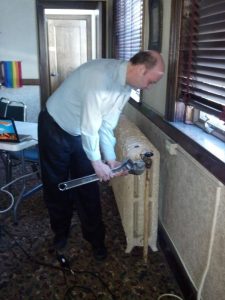
One weekend, I was in the middle of fixing a leaky steam radiator when I realized I needed a part. I thought it’d be polite to leave a “be right back” note so no one thought the radiator was abandoned, so I headed to the reception desk to quickly make a sign. But, as often happens in a quirky church, this little project was turning into more work than the actual repair.
I found a piece of paper, but there wasn’t a marker in sight. After digging around, I came up with a couple of old funeral home pens, which each sputtered out after a word or two. In the end, I resorted to a crayon. Next, I needed tape, but the only thing on hand was some weak, yellowed tape that barely stuck to anything. It wouldn’t hold on the radiator, so I decided to stick my makeshift sign to the wall, only to remember this would require official blue painter’s tape, which, naturally, was locked up in a basement storage locker.
Down I went to the boiler room, where I found the tape just barely out of reach inside the locker. I grabbed a ladder and tried to fish the roll out, but it slipped further down. If only I had a hook—or, ironically, some actual sticky tape to help me grab it. Then I remembered that a volunteer kept a stash of supplies in one of those small school lockers nearby. He’d told me I could use anything if I kept it locked afterward, but, of course, I couldn’t recall the combination.
Back upstairs, I found a microphone stand, slapped my crayon-written sign on it with the weak yellow tape, and set it next to the radiator. As I was about to leave, it finally hit me—the combination for the locker was written on the side of it! I hurried back down, retrieved some tape (which, naturally, wasn’t the regulation blue), and headed out the door.
On my way out, a building renter noticed the microphone stand contraption “blocking” the hallway and asked what on earth it was. I gave up, grabbed the stand and my makeshift sign, and shoved both in a closet. In the end, I leaned my humongous wrench against the radiator and left, figuring anyone would get the message.
Apparently, in the twenty minutes I was gone, someone noticed the wrench and set off an email chain reaction. They sent out a message asking if anyone knew what was happening with the radiator, and before long, dozens of emails were flying back and forth. With each addition to “reply-all,” the mystery grew. Everyone was baffled about why my massive wrench was propped up there and what it meant. They debated the radiator’s status, acknowledging it was the one that had been dripping all week, and they mused over whether someone was finally working on it.
The confusion only deepened when, a few hours later, someone reported that the wrench had mysteriously disappeared—and so had the leak. People started guessing that maybe I’d been working on it, given that I’m the only licensed boiler engineer and, apparently, well-known for lugging around that monster wrench.
Days later, I heard people were upset with me for not “communicating better” when I left for parts. The funny thing? Not one of those emails included me on the thread, and nobody bothered to just ask me about it. Honestly, I thought I’d done a pretty solid job of communicating—after all, I’d left behind a universally recognized symbol of “I’ll be right back”—my wrench!
Speaking of a trail of evidence…
I had quite a reputation for leaving a trail of evidence whenever I worked on anything mechanical. The custodian called it “job security”. Like the time I was showing the custodian the fresh air intake for the new furnaces.
He was going to help me with a smoke bomb test later that day to visualize airflow in the sanctuary. As I popped open the access door, I warned him, “Watch out—18,000 CFM of air is about to get sucked in.” I barely finished the sentence before the box of packing peanuts he was holding got sucked in, too. They went down three stories, straight through the blower fans, shredded to bits, and shot out of a hundred vents under the pews.
We sure got a good look at the airflow that day—along with a confetti of packing peanuts and a perfectly visible trail of “evidence” left behind!
This box does not contain cat food
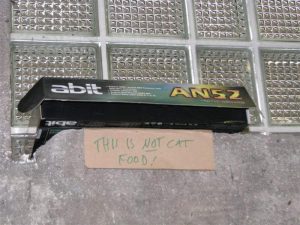
One winter I noticed a cat hanging out in the boiler room stairwell from time-to-time. I wasn’t sure if he was a local cat or a stray, but for sure he would die of exposure before I would find out. So I made up a nice cardboard box with a protected entry hole and put some old towels in it along with a bowl of water. I found a secluded spot behind some shrubs for my make-shift cat house where I could keep an eye on it while working late nights. I made an alternate emergency exit so the cat would feel safe from predators.
The next day I brought in some cat food only to find the house pulled out into the alley. So I put a note on it saying that this is a cat house and put it back behind the shrubs. The following day the house was in the dumpster. So I put it back with another note about the freezing cat. Next day back in the dumpster it went along with my supply of cat food. I was informed that this was a safety and health issue – we can’t have things like this on the property.
When I brought in more cat food I was told to throw it away since it would attract critters. The cat got rescued so what was the most logical thing to do with the cat food? I put it in a computer box and labeled it “This is not cat food!”
The box of cat food remains undisturbed on my workbench for the next time a cat shows up in the alley. Now I know the proper way to label a cat house!
Mayberry jail key ring
In The Andy Griffith Show, the jail keys always hung conveniently on a hook right by the cells—just out in the open, handy enough that Otis, the town drunk, could stroll in and lock himself up as needed. So, you can imagine my surprise when I discovered that the church’s master keys were handled in much the same spirit.
In the top drawer of the public reception cabinet sat the mother of all key rings: a colossal, jangling mess of metal with a key for everything—the file cabinets, the doors, the padlocks, the vending machine, even a safe, and a couple of ancient skeleton keys that must have unlocked something at the church when it was first built. It was ridiculously convenient for my tech team. Any time we had to pull wiring or troubleshoot equipment between offices, we could just grab the ring and go. But I couldn’t help wondering why they didn’t have a proper lockbox with numbered tags for each key—wasn’t that a safer, more organized approach?
Well, as they say, careful what you wish for at All God’s Children.
A few years later, someone decided it was finally time for a “secure” key management system. What did we get? A three-ring binder stuffed with plastic page protectors, each one modified to hold a single key alongside a numbered card referencing a master list. To top it off, there was a sign-out sheet that you had to fill out every time you used a key. So, if we needed six office keys to lay down some network cables, we had to sign out the first key, sign it back in, grab the next one, sign it back out—you get the idea. Not only was it absurdly clunky, but in this grand “upgrade,” most of the keys had mysteriously vanished. And where was this fancy binder kept? Right in that same old unlocked drawer.
It didn’t take long to see the real purpose behind this new “system.” It wasn’t about securing access or controlling key distribution—it was about controlling us. It was like they decided to make up hoops to jump through just to remind us who held the keys to the kingdom. The irony? It actually made things worse. The binder was so inconvenient and condescending that it fell into disuse.
In the end, Otis’s old jailhouse setup probably would have worked a lot better for us too.
Tree needs water
One evening while working at the church, I went out to my car when one of the neighbors waved me down. She wanted to tell me how much she loved the new landscaping by the parking lot, but there was one little tree she was worried about. It looked like it might not make it without some water. She admitted that she’d done her part last spring, hauling buckets of water from her house, but this year she didn’t have the strength for that. I told her I’d make sure someone watered the tree tomorrow, to which she responded, “That’s what they said last spring.” I realized I had to take care of it right then and there—and, of course, without using her water for our tree.
There was just one problem: the church’s outside water wasn’t turned on yet. All it would take was flipping a valve, but it came with that special All God’s Children kind of dilemma: Do I turn it on, and if so, do I leave it on or turn it back off? Simple questions at most places, but at AGC, they become philosophical debates.
The logical approach was to activate the irrigation system and get the closest sprinkler head going, but there was a hitch: the church had hired a pro to turn on the system later that week, and he’d know immediately if the sprinklers had been tampered with. The next option was grabbing a hose, which sounded reasonable—until I remembered the hose was locked in the gardener’s closet with a heavy-duty padlock.
In the end, I took the coward’s route. Bucket by bucket, I hauled water up the rickety back stairs to that little tree, all the while hoping my common sense would make a good impression on our neighbor. With any luck, it was enough to help the tree survive and keep her from lugging water over here again.
AGC-86
Occasionally there would be a guest singer that simply did not have a good voice. If they were part of the choir the music director would ask me to adjust the microphones for a “better balance” which meant to turn down the mic closest to them. This usually worked and nobody was the wiser.
It was much more of a challenge when a vocally challenged guest singer joined our praise team. Each singer had their own handheld microphone, but it didn’t do any good turning down the offensive vocalist. If they could not hear themselves in the speakers, they would just sing louder and closer to the microphone.
I came up with a plan to let the guest singer save face while sparing the ears of the congregation. When the music director noticed the problem, he would ask for an AGC-86 microphone to better suit the vocalist. There is no such microphone. This was a code for me to put plenty of the vocally challenged singers own voice in the floor monitor speaker next to him and none of his voice in the house speakers that the congregation hears. The vocalist could now hear himself sing his heart out while the others worked to drown out his sour notes.
This was a win-win solution that let us get through many days without hurting anybody’s feelings. That is until the church control freak got involved by not getting involved.
At a national conference the director rooted out a sour voice during rehearsal just as our resident control freak was walking by. She insisted that this person had a great voice – she heard him sing a few months ago at our church. She questioned if they were using the correct microphone for his voice. She made some phone calls to our church and discovered that the microphone that I used with this singer was an AGC-86. When pressed for what she was trying to do she replied that “this is all Greek to me” and that she just needs the name of the microphone. Of course, nobody in the professional sound crew knew what she was talking about, but she would not let it go. She talked to everybody, except me, insisting that they go out and purchase a AGC-86. When it was all over the challenged vocalist was humiliated, the director frustrated, and I looked like a fool to the pro sound crew. The control freak assumed that I was incompetent so upon returning home none of this was mentioned to me.
Etiquette
Surprisingly, the church has no place to go that is quiet and private. In the days when I was spending upwards of 50 hours a week at church, I cherished the little hideaways that I devised to get a little R&R. One such place was the loft in the basement storage room. Understand that this was in a 100-year-old creepy cellar that was once the hold for coal, however it was warm and quite comfortable.
One evening I was taking a cat nap before a bunch of meetings. Two people came back to the storage area to get supplies for their AA meeting. I did not expect anybody this early, so I just froze motionless so as not to disturb them. Several minutes went by without hearing anything. No voices. No door squeaks. Just dead silence. This was very strange. Making any noise repositioning myself was simply not an option so I continued to wait it out. After ten more minutes of silence, I methodically inched my way across the loft so I could have a look. They were making out!
Do I scare the hell out of them by saying something from the creepy depths of an old church?
-OR-
Do I remain silent hiding out as a creepy peeping Tom?
-AND-
Exactly how long do I wait before doing something?
Rival gangs and tailgating
I was up in the balcony getting setup for a funeral as the crowd gathered below. I couldn’t help but notice the left and right sections were getting almost full while the center section was completely empty. The Pastor came up to get his microphone and go over final details of the Service with me. He looked down at the large crowd and suddenly blurted out “I just figured it out!” He continued, “I knew I was missing something during the planning of this funeral”. He paused before saying, “these are two rival gangs!”
Everybody stuck to their respective sides of the sanctuary throughout the Service without incident. You could sense the tension yet everybody remained respectful and civilized.
It took me about an hour to put things away and was just about to secure the building when I noticed the parking lot quickly filling up again. The crowd had returned from the graveside interment and were now tailgating in our parking lot. I decided to stick around since it had all the makings of trouble. They finally left at 9 pm. The last person to leave collected all the containers and left the parking lot spotless.