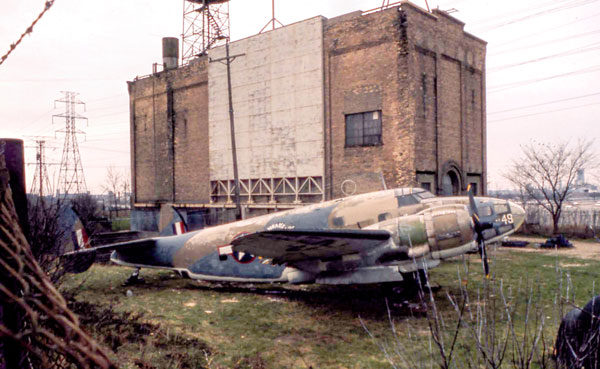
There was an odd and little known building in St. Paul. It was several stories high with a tall lightning rod on top. This was not to repeal lightning but rather to attract it! Occasionally, in the dark of night, a bolt of lightning would arc from a building doorway and zap a World War II-vintage airplane, adding to the mystique about the place.
The Lightning and Transients Research Institute was a facility located in Lauderdale, Minnesota, near St. Paul, that conducted experiments on the effects of lightning on various structures and devices. The institute was founded by University of Minnesota faculty in the 1940s and operated until the 1970s. It had a contract with major airplane manufacturers and helped develop federal standards for aircraft and electrical component shielding.
The most striking feature of the institute was the presence of a World War II-vintage airplane, a Lockheed RB-37 bomber, that sat next to the building and was used as a test subject for simulated lightning strikes. The plane was one of a group of bombers that were originally intended for use by the British through the Lend-Lease Act, but never sent overseas. The plane was subjected to strikes of up to 200,000 amperes and 700,000 volts to determine how lightning affected its radio components, radar gear, navigational components and metal skin.
The building housed a three-story array of transformer coils and capacitors that could generate artificial lightning bolts. The building also had a trolley-like device that could be rolled out a door to send the bolts at the plane or other parts of aircraft that were scattered around the grounds. The building had a nondescript appearance and did not reveal much about the nature of the research that was conducted inside.
The Lightning and Transients Research Institute was a pioneer in the field of lightning protection and contributed to the safety and reliability of aviation and other industries. Today, the site is an Xcel Energy substation and the plane is no longer there.