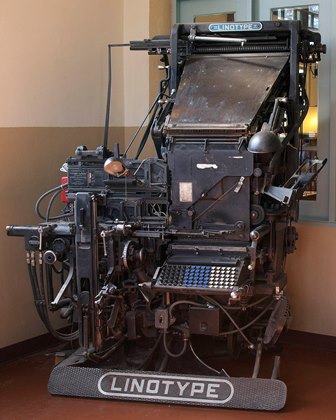
I am afraid that I am going to have to insist that you are amazed by this machine – because it is well, amazing. Do you know how they set type for printing presses for 100’s of years? A small army of typesetters would select individual lead letters and assemble them row by row to make up a page. (Luther in the Ghost and Mr. Chicken) This was tedious and took just about forever to do. But not nearly as long as the task of returning each letter to the appropriate little compartment within a case for reuse next time around. I know because this is how my first printing press worked. If you look at it in this museum you will notice that the type for the last thing I printed 50 years ago has still not been returned to the type case.
Imagine if you had a robot to do all this for you. You just type the letters and it does all the work for you. Now imagine that the robot is the child of Dr. Seuss and Rube Goldberg. The Linotype. The world’s most complicated mechanical marvel that amuses me every time I see it in action. There are knobs, wheels, gears, cams, belts, chains, dials, sliders, arms, cranks, buttons and lots and lots of moving parts. The moving parts have moving parts. How many machines do you know of that have metal ingots being lowered by chains into a caldron of molten lead? How about an arm that reaches down to grab your finished work and deliver it to the top of the machine where it meets up with another arm?
The Linotype was a “line casting” machine used in printing. It was a hot metal typesetting system that cast blocks of metal type for individual uses. Linotype became one of the mainstay methods to set type, especially small-size body text, for newspapers, magazines, and posters from the late 19th century to the 1970s and 1980s, when it was largely replaced by phototypesetting, offset lithography printing and computer typesetting. The name of the machine comes from the fact that it produces an entire line of metal type at once, hence a line-o’-type, a significant improvement over the previous industry standard, i.e., manual, letter-by-letter typesetting manually using a composing stick and shallow subdivided trays, called “cases”. Capital letters were in a case above the case for small letters, hence the term “lower case” for small letters.
The linotype machine operator enters text on a 90-character keyboard. The machine assembles matrices, which are molds for the letter forms, in a line. The assembled line is then cast as a single piece, called a slug, of type metal in a process known as hot metal typesetting. The matrices are then returned to the type magazine from which they came, to be reused later. This allows much faster typesetting and composition than original hand composition in which operators place down one pre-cast glyph (metal letter, punctuation mark or space) at a time.
The machine revolutionized typesetting and with it especially newspaper publishing, making it possible for a relatively small number of operators to set type for many pages on a daily basis.
