_test nostalgia photos

Mid-Century Console Stereo System
Featured is a quintessential mid-century console stereo system, an elegant amalgamation of furniture and high-fidelity audio technology. During the 1950s through the 1970s, these systems were the centerpiece of many living rooms, offering not just music playback but also serving as a significant decor element. With a wood veneer finish and slatted grillwork, the console houses a record player, radio tuner, and sometimes even a television or tape player, reflecting the era's love for multifunctional furniture.

This particular console stereo is open to reveal a turntable, indicative of the vinyl records' golden age. The audio produced by such systems was rich and deep, filling the room with sound from large built-in speakers. Ownership of such a piece signaled a household's commitment to both musical appreciation and interior aesthetics. As a testament to design and technology merging harmoniously, console stereos are remembered for their role in social gatherings and family entertainment.
20th Century Vaccine Gun
This is a vaccine gun, a device designed to deliver vaccinations quickly and efficiently without the use of needles. This particular model could be loaded with a dose of vaccine, and with a simple press against the skin, it would deliver the medication through a fine, high-pressure jet. It was an innovation aimed at mass immunization campaigns, where traditional needle and syringe methods were too slow to respond to urgent public health crises.
The vaccine gun played a critical role in the global effort to eradicate smallpox, allowing health workers to vaccinate large populations swiftly. Unlike syringes, it could be used repeatedly without the need for sterilization between each shot, making it invaluable in areas with limited medical infrastructure. While more modern delivery methods have replaced these guns, they stand as a significant milestone in the history of medicine, representing the ingenuity of public health initiatives in the fight against infectious diseases.
20th Century Vaccine Gun
This is a vaccine gun, a device designed to deliver vaccinations quickly and efficiently without the use of needles. This particular model could be loaded with a dose of vaccine, and with a simple press against the skin, it would deliver the medication through a fine, high-pressure jet. It was an innovation aimed at mass immunization campaigns, where traditional needle and syringe methods were too slow to respond to urgent public health crises.

The vaccine gun played a critical role in the global effort to eradicate smallpox, allowing health workers to vaccinate large populations swiftly. Unlike syringes, it could be used repeatedly without the need for sterilization between each shot, making it invaluable in areas with limited medical infrastructure. While more modern delivery methods have replaced these guns, they stand as a significant milestone in the history of medicine, representing the ingenuity of public health initiatives in the fight against infectious diseases.
First Xerox machine
First Xerox machine
The Xerox 914, introduced in 1959, was the world's first commercially successful plain paper photocopier. This revolutionary machine transformed offices by making copying fast, easy, and affordable. Prior to its invention, copying documents was a cumbersome process involving carbon paper or messy mimeograph machines. The Xerox 914 used a groundbreaking xerographic process, where images were transferred onto plain paper using static electricity and toner. Its success marked the beginning of the modern era of office automation, and it became an iconic symbol of mid-20th century technological innovation. Despite its large size and occasional tendency to overheat, the Xerox 914 became an indispensable tool in businesses worldwide.
Library Regiscope
Library Regiscope
The Library Regiscope, used primarily during the mid-20th century, was a specialized photographic device designed for capturing images of library users' identification documents, such as library cards and ID photos. This technology was part of a broader effort to improve security and record-keeping in public libraries, ensuring that borrower's information was accurately documented and easily retrievable. The device typically worked by photographing the identification document onto microfilm or another small format, allowing libraries to store large volumes of records in a compact space. The Regiscope represents an early intersection of photography and data management in public institutions.
Voting machine
Voting machine
The mechanical voting machine, first introduced in the early 20th century, represents a significant advancement in the history of electoral technology. Designed to ensure the integrity and efficiency of the voting process, these machines allowed voters to make their selections by pulling levers corresponding to candidates or issues. Once a voter completed their choices, a lever would record the vote and reset the machine for the next user, significantly reducing the risk of human error and tampering. These machines were widely used in elections across the United States for much of the 20th century, embodying the era's trust in mechanical solutions for civic processes. Despite being phased out in favor of electronic systems, mechanical voting machines remain an important symbol of the evolution of democratic practices.
Voting machine
Voting machine
Voting machine
Voting machine
Voting machine
Voting machine
 
The library card catalog, a staple of libraries from the 19th to the late 20th century, was the primary system for organizing and locating books and other materials before the advent of digital databases. Comprised of wooden drawers filled with cards, each card provided essential information about a specific item in the library's collection, including the title, author, subject, and location. Users would search the catalog by flipping through the cards to find what they needed. The card catalog was an essential tool for librarians and patrons alike, embodying the meticulous organization and accessibility of knowledge in a pre-digital age. Its legacy endures as a symbol of the enduring value of libraries and their role in preserving and sharing information.
Kodak Instamatic camera
The Kodak Instamatic Camera, first launched in 1963, marked a significant milestone in the history of photography by making it more accessible to the masses. Designed with simplicity in mind, the Instamatic used a drop-in film cartridge, eliminating the need for threading film and making photography easy even for beginners. Its compact design and affordable price quickly made it a popular choice for families and amateur photographers. The Instamatic series helped popularize the concept of point-and-shoot photography, allowing users to capture moments effortlessly. With millions of units sold worldwide, the Kodak Instamatic played a key role in democratizing photography, bringing the joy of capturing everyday moments to people everywhere.
Mid-Century Console Stereo System
Featured is a quintessential mid-century console stereo system, an elegant amalgamation of furniture and high-fidelity audio technology. During the 1950s through the 1970s, these systems were the centerpiece of many living rooms, offering not just music playback but also serving as a significant decor element. With a wood veneer finish and slatted grillwork, the console houses a record player, radio tuner, and sometimes even a television or tape player, reflecting the era's love for multifunctional furniture.

This particular console stereo is open to reveal a turntable, indicative of the vinyl records' golden age. The audio produced by such systems was rich and deep, filling the room with sound from large built-in speakers. Ownership of such a piece signaled a household's commitment to both musical appreciation and interior aesthetics. As a testament to design and technology merging harmoniously, console stereos are remembered for their role in social gatherings and family entertainment.
Library Regiscope
The Library Regiscope, used primarily during the mid-20th century, was a specialized photographic device designed for capturing images of library users' identification documents, such as library cards and ID photos. This technology was part of a broader effort to improve security and record-keeping in public libraries, ensuring that borrower's information was accurately documented and easily retrievable. The device typically worked by photographing the identification document onto microfilm or another small format, allowing libraries to store large volumes of records in a compact space. The Regiscope represents an early intersection of photography and data management in public institutions.
SRA Reading Laboratory Kit
The SRA Reading Laboratory Kit, developed in the 1950s by Don H. Parker and published by Science Research Associates (SRA), was a pioneering educational tool designed to enhance reading comprehension and literacy skills. This self-paced learning kit consisted of color-coded cards, each containing reading exercises and questions that corresponded to different levels of difficulty. Students would progress through the levels as they improved, allowing for personalized learning within a classroom setting. The SRA kits became widely popular in schools across the United States and beyond, recognized for their effectiveness in promoting independent learning and critical thinking. This innovative approach to education reflects the mid-20th century's emphasis on individualized learning and mastery of foundational skills.
SRS learning kit
SRA Reading Laboratory Kit
SRS learning kit
SRA Reading Laboratory Kit
LePage's Mucilage Adhesive, circa 20th Century
This bottle is LePage's Mucilage, a plant-based adhesive once common in homes, offices, and classrooms. Known for its distinctive bottle with a rubber tip applicator, LePage's Mucilage was used for bonding paper, cards, and other light materials. The glue was derived from natural gums, a sap-like substance extracted from certain trees and plants, which provided an eco-friendly bonding agent before the wide availability of synthetic adhesives. This particular packaging reflects the mid-20th-century design, with its iconic red cap and amber-colored bottle. LePage's Mucilage was a precursor to the modern glue stick and remains a nostalgic reminder of past office supplies and crafting materials.
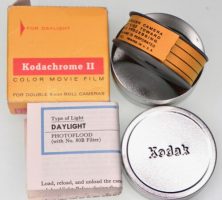
Kodachrome II Color Movie Film and Canister, circa 1960s
This is a box of Kodachrome II 8mm color movie film accompanied by its metal storage canister, a product that holds a significant place in the history of photography and cinematography. Kodachrome was the first successfully commercialized color film that used a subtractive color method to create images. Introduced by Eastman Kodak in the 1930s, Kodachrome was renowned for its rich color reproduction and long archival life, making it a favorite among professional and amateur photographers alike.

The Kodachrome II variant, suitable for daylight shooting, was introduced in the early 1960s, offering greater speed and finer grain than its predecessors. This film was widely used for capturing home movies, travelogues, and important life events, immortalizing moments with vibrant hues and crisp details. It required complex processing that was available through Kodak's dedicated facilities. The sturdy metal canister provided a protective and lightproof housing for the film before and after exposure.
Kodak 110 film
Introduced by Kodak in 1972, the 110 film format revolutionized amateur photography by offering a compact, easy-to-use option for capturing memories. The 110 film was housed in a small, plastic cartridge that was simple to load, making it highly popular among casual photographers. Each cartridge contained 24 or 12 exposures of 13mm × 17mm negatives, producing smaller images but with the convenience of portability and ease of processing. The format became synonymous with pocket-sized cameras, allowing photography to be more accessible to the general public. Although eventually overtaken by digital technology, Kodak 110 film remains a nostalgic symbol of 1970s and 1980s photography.
Kodak film
Kodak film